A Cool Drink of Water (Ephraim Beason)

Ephraim means “I will be doubly fruitful or doubly blessed.”  In the Bible Ephraim was the name of Joseph’s son in the book of Genesis.  Ephraim’s grandfather Jacob spoke a blessing over Ephraim and his brother Manasseh.  This blessing is still spoken over others.  “May God make you as prosperous as Ephraim and Manasseh.”  (Gen 48:50). 

Ephraim Beason was named by his parents on the day of his birth on June 20, 1858 in Osceola, St. Clair County, Missouri.  His parents were Joseph and Samantha Beason. 

Ephraim Beason questioned the meaning of his name many times in his life.  He didn’t feel doubly blessed or fruitful.  Being born in 1858 in Missouri, he was only three years old when the Civil War began in 1861.  Missouri was a hotbed for the war and there was much upheaval and unrest.  Ephraim’s oldest brother, Nathan joined the Confederate Army under General Sterling Price in June of 1861, when Eaph was three years old. 

June 20, 1861 was a difficult day for the Joseph Beason family.  Living in the state of Missouri they were caught in the middle of a state on both sides of the Civil War.  Missouri did not secede from the Union but was considered the 12th state of the Confederacy.  On August 10, 1861 the Battle of Wilson’s Creek resulted in a Union defeat leaving the southwestern part of Missouri in Confederate hands.  Joseph and Samantha’s oldest son, Nathan decided to join the Confederate Army in June of 1861.  Eaph was only three years old and was so sad to see his dear brother go to war.  He didn’t understand what was happening but could sense that his parents were deeply concerned.  Nathan used to take Eaph with him on all kinds of adventures and Eaph certainly missed these times.  Excitement filled the home when Nathan would show up at the old home usually at night.  They were always unexpected and unannounced but the celebration in the family was joyous.  Many times the Union soldiers would circle the house on horseback and throw open all the doors and search their home.  This was so frightening for a three year old.  They rushed in with pistols and searched upstairs and down.  They threatened his father with death as they were leaving. 

Ephriam remembered the early September morning in 1863 when his family loaded their wagon with a few things from their home and fled north not knowing where they were going.  The Union soldiers told Joseph that they would kill him because he was considered a Confederate sympathizer as he had a son in the Confederate Army if he did not vacate his farm on September 9th due to ORD number 11.  He was also told he would be killed if he had a gun.  They searched his home and farm for a gun but did not find one.  Samantha had taken a tip from Genesis 31:34 “Now Rachel had taken the images, and put them in the camel’s furniture, and sat upon them.  And Laban searched all the tent, but found them not.”  They had disassembled Joseph’s gun and put in the bottom of the trunk of clothing and Samantha sat on it and held little Melissa who was frightened and sobbing throughout the ordeal. 

The family was filled with grief with abandoning their farm and upon hearing the news of their son Nathan’s death.  The farm tools and machinery and furniture had to be left behind for the scavengers.   They traveled 85 miles north of their home.  The Beason family kept moving north renting farms along the way. 

Eventually they moved to Waubonsie Creek, Iowa in 1877.  Ephraim and his father chopped wood for W.D. Stephens.  W.D.  Stephens had a beautiful daughter named Adenia.  WD made a big mistake and sent this daughter out to give Ephraim a cool drink of water.  Eaph was 20 years old and Adenia was 17.  It was love at first sight.  Eaph’s sister Melissa had also fallen in love with Jim Mackey.  A cool drink of water while chopping wood on a hot summer day has been the fall of many a good man.  Secretly they decided to elope and have a double wedding.  They got together on the evening of September 10, 1878 and started for Missouri with a team and buggy.  They had heard that the marriage laws were more lenient in Missouri.  The Justice of the Peace in Hamburg, MO was abruptly awakened from his deep sleep at 12:30am and a double wedding took place in his home at 12:45am with his wife as the witness.  At daybreak the young couples found they were close to cousin Silas Beason’s house and stopped there for their wedding breakfast.  

Ephraim worked many different jobs to earn a living for his new bride.  He worked in a brickyard, tended crops, cut and hauled wood, and many other odd jobs.  Adenia did housekeeping and tended to Ephraim’s brother Joe’s children as their mother had passed.  Adenia became very ill and was in a coma for three or four days.  She woke up just a few days before giving birth to her daughter Rosa May Katherine in June of 1879.  When she woke up she did not remember Eaph or marrying him.  It took a few days for her memory to return. 

Their second child Joseph William (Willie) was born on June 10, 1881 and Rosa May Katherine succumbed to typhoid fever that same year in October.  The next spring the Missouri overflowed taking away their house and all of their belongings.  They nearly lost their lives. 

Another tragedy struck the family in the spring of 1888 when Willie was accidentally struck by a large log that was being unloaded from a wagon load of boards.  The doctor was called and the preacher and church members came to pray for Willie but he died that night about midnight.  Eaph and Adenia were grief stricken and inconsolable. 

At this time of great loss Ephraim’s eyes were opened to his great sin.  He was a big rough and tumble man and a good fight was something he enjoyed.  He carried the scars of a fight all of his life when a couple of guys jumped him and hit him with brass knuckles.  Eaph knew if he wanted to be with his children again in heaven, he needed to get right with God.  He converted and joined the church and started preaching the next year in 1889.  He found the Lord was his cool drink of water in his grief and in the midst of his struggles.  Jesus said in John 4:14, “But whoever drinks of the water that I will give him shall never thirst, but the water that I will give him will become in him a well of water springing up to eternal life.” 

Eaph loved to tell the story of the love of Jesus and how Jesus is the only hope for a life full of scars and tragedies.  He and Adenia moved to WaKeeney, Ks and had ten more children.  My great-grandmother Olive Livinia Beason was one of them.  In WaKeeney Ephraim owned a blacksmith shop and also preached in many school houses in the area.  He traveled by horse or horse and buggy.   He didn’t have a circuit that he traveled but he preached whenever he was given the opportunity. He took my great-grandmother Olive with him to many of these services and she was a great singer.

“Give me one hundred preachers who fear nothing but sin and desire nothing but God, and I care not a straw whether they be clergymen or laymen; such alone will shake the gates of hell and set up the kingdom of heaven on earth”.  John Wesley

He was a stern and serious man but he could belt out the songs of His Savior.  In the evening after working in the blacksmith shop, he would sit on the front porch and read the newspaper with his wife Adenia, with a cool drink of water.  His grandchildren shared that they were a little afraid of this big grandfather.  But sometimes he would laugh so hard and long that it seemed to rock the whole house.  He could sing well and loud.  He sang songs like, “There’s Power in the Blood” and “When We All Get to Heaven”. 

Adenia was a very happy person and was always praising the Lord.  She carried her Bible with her most places and would share scriptures and have a word of prayer for those in need. 

Ephraim and Adenia found that their Lord and Savior was more than enough to carry them through life’s challenges.  They found that He is just what He said He is.  He is the “living water” and you will never thirst again because His well shall never run dry.

Jeremiah 17:13 Yahweh, you are the hope of Israel!  All who forsake you will be covered with shame.  Those who turn away from you will be written in the dirt.  To forsake you, Yahweh, is to forsake the fountain of living waters. 
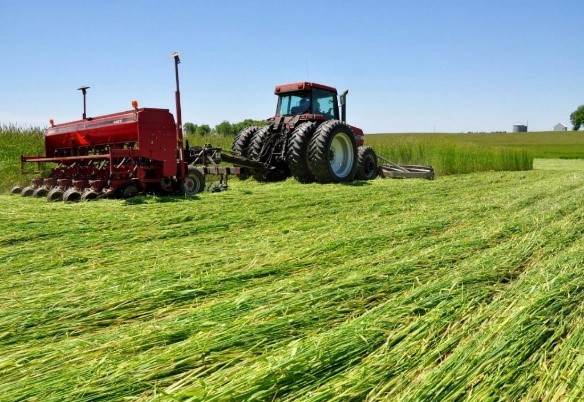
Wheat Planting on the Prairie

Wheat Planting Time on the Prairie

Mid-September to the first of October is the ideal time to plant wheat here on the prairie.  Wheat was always the primary crop that we planted on our farm when we were farming full time.  The farmers work all year to raise that crop as that is your main source of income for the year.  It is vital to the success of the farm, family and finances.  Because of these dynamics it can be a very stressful time of year.  Much work must be accomplished on the farm to care for the crops and the animals with the winter months fast approaching.  We usually carried over a truck load of wheat from last July’s harvest so that it could be used to plant or drill the new crop of wheat.  This seed wheat needs to be cleaned to remove trash and make it as clean as possible to plant. 

John 12:24 Truly, truly, I say to you unless a grain of wheat falls into the earth and dies, it remains alone; but if it dies, it bears much fruit. 

One year the land we were planting wheat on had not been prepared as properly as the Farmer liked it to be.  Some of the weeds on one piece of ground had grown too big and we couldn’t get the ground worked with the tractor and sweep machine as much as we liked.  So we decided to drill the wheat while we still had some moisture and began the process.  The Bride is the Farmer’s only hired man as the sons and daughter were in school. 

The Farmer’s plan was that the Bride would help to load the drill with seed wheat with 5 gallon buckets as he was down in his back and couldn’t do all that he wanted to do.  This process went along pretty well.  It was during the next step that the problems began to appear.  The Farmer drove the tractor while the Bride rode on the drill to make sure we could get through the weeds and that the seeds were going into the ground as they should.  Because we know from the scripture above, unless the wheat falls into the ground and dies it does not produce and we needed much fruit! 

This plan, although a good one did not work well as the Bride got over whelmed with her duties and fell quite behind.  The Farmer always has a good plan B ready and we changed spots.  The Bride drove the tractor while the Farmer rode on the drill.  This was better but the Bride was very concerned that she would knock her precious Farmer off of the drill with her antics as the driver.  Also the tractor is very noisy and it makes it extremely hard to hear the Farmer and his instructions.  The Bride has never understood Farmer sign language.  She did however understand that she was to stop the tractor when the Farmer began to hit the drill with a crow bar with great force.  He said he was not angry he was just trying to get the Bride’s attention to STOP the tractor. 

Life is like a field, where we must gather what we grow, weed or wheat…this is the law, we reap the crop we sow.  – Patience Strong.

Needless to say, it was a long day and there were some marriage issues that arose BUT the wheat did finally get drilled and a very tired Farmer and Bride got home to a nice warm shower after a strenuous day in the dirt. 

Over the River and Through the Snow

November 1952 found quite a snowstorm from the Texas and Oklahoma panhandles and it stretched northward to the Minnesota lake country.  It turned the Great Plains region into a frozen wasteland and slowed pre-Thanksgiving holiday travel to a crawl.  Winds swept this storm through northeastward on winds reaching 60 mph. 

“Moving rapidly out of Oklahoma and Texas, the storm shrieked across Kansas, Missouri, Nebraska, Iowa, South Dakota, Minnesota and Wisconsin and spread to the mountain states of Colorado, Wyoming and Montana.  Winds whipped the seven inch snowfall in Nebraska into towering drifts.”   –taken from the Madera Tribune, November 1952.

In August of 1951 Alta Mae Brown left her home in Blackburn, Oklahoma and traveled to Eads, Colorado to assist her sister with the birth of her first child.  Her sister, Norma Rose and her husband, Leo worked for the Jillie and Cannon Construction Company.  This company built telephone lines and electrical lines.  They built the lines that would bring electricity to rural communities and farms.  They traveled to wherever the company had a contract and went to work.  They often moved their families with them in trailer homes or apartments.  These linemen were a hearty bunch of men who braved the elements, the mountains, swamps, and etc. to move electricity across this country. 

“In the United States, the rural electrification drive during the New Deal led to widespread expansion in the number of jobs in the electric power industry.  Many power linemen during that period traveled around the country following jobs as they became available in tower construction, substation construction, and wire stringing.  These roving workers or “boomers” as they were called, were known as risk takers but also as hard workers with a strong sense of pride in their work.”  –taken from Lowell Corp.com “The Evolution of the Lineman”. 

Alta Mae was a beautiful young woman and she happened to meet one of her brother in law’s co-workers.  His name was Elvin Jamison and he was from a farm in northwest Kansas.  He had been discharged from the US Navy in June of 1946 and was so thankful to get back to the farm in Quinter.  All of his letters home to his parents on the farm talked of his longing to return home for harvest.  He was on a ship near the equator part of the time and near the Philippines.   When he did get home for harvest, he had to wear a coat as he felt cold even in July in Kansas.  His uncle was working for the Jillie and Cannon Construction Company and he convinced Elvin and his brothers that there was good income for linemen.  They went to work for the company and moved to several different places with the crew.   

“Home wasn’t a set house, or a single town on a map.  It was wherever the people who loved you were, whenever you were together.”  – Sarah Dessen

There seemed to be some real fireworks go off between the two when they met.  Alta Mae thought she had met a rich Kansas farmer and Elvin thought he had met a rich woman of Native American heritage from Oklahoma.  They both said later that they were both fooled.  They did elope two weeks after meeting.  They drove to Raton, New Mexico and were married by the Justice of the Peace on August 18, 1951. All of their belongings fit into the back seat of their car.  Norma Rose’s elder sister completely abandoned her before her child was born. 

For Thanksgiving 1952, Elvin, Alta Mae, Elvin’s younger brother Bobbie, his wife Loretta, and their seven month old baby boy decided to pile in the car and head back to the farmstead in northwest Kansas for the Thanksgiving holiday.  They were currently residing and working in Clovis, New Mexico.  The weather was good as they embarked on this journey and the young couples were excited to get home.  Elvin and Alta Mae were expecting their first child and they all enjoyed Mike, the adorable baby boy. 

As they reached the Oklahoma panhandle the weather began to take an ominous turn.  In 1952 there were not many phones available in small towns and certainly there were no cell phones.  The weather forecasting was not as technical in that day and many cars did not have radios.  The wind began to pick up and the snow was heavy and it was blowing.  This greatly reduced their ability to travel.  Road closures began to impact their progress and the car heaters in that day were marginal, especially with 60mph winds.  As there was really no place to stay the two young brothers continued to fight their way home.  They knew if they could reach the farm there would be warmth, food and good times with family. 

Some of the way they were not able to stay on the roadways but took to pastures and other ground where the snow was blown off of the fields.  They let down some fences to pass the vehicle through and picked their way carefully home.

Their parents were very concerned about them but could get no report on their progress.  Imagine their excitement when they finally saw the car coming down the driveway to the farm.  Their precious sons, daughter-in-laws and grandbaby had arrived safely at the farm. 

“It’s a funny thing about life, once you begin to take note of the things you are grateful for, you begin to lose sight of the things that you lack.” –Germany Kent

Baby Mike however became very ill with pneumonia from the treacherous journey and just barely escaped death.  With all of the love and warmth of the family his life was spared and this family had a tremendous Thanksgiving, celebrating life, family, gratitude and love.  They thanked the Lord for His help on a very difficult trip and for sparing the life of this precious little one.